
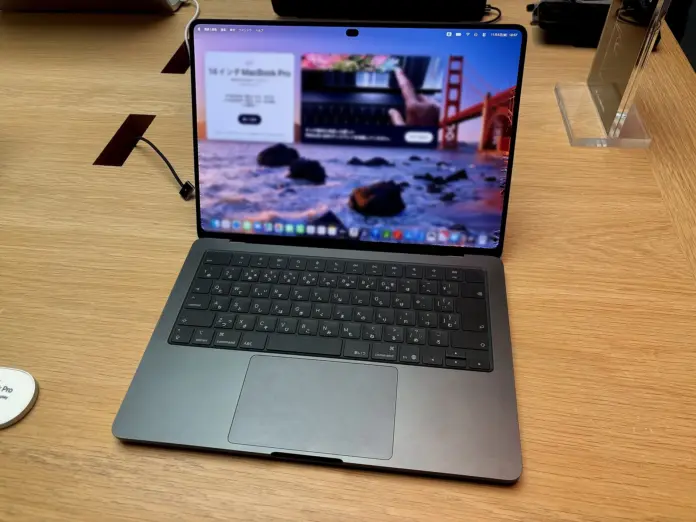
Apple’s first touchscreen MacBook Pro went on sale on Friday, November 6, 2026. Called the MacBook Pro with PROLED XDR Display, it comes in 14-inch and 16-inch sizes with M5 Pro or M5 Max chips and starts at $2,899 in the US. Apple announced it on October 28 and opened pre-orders the same day in 30 countries and regions.
Prices
- 14-inch with M5 Pro: $2,899 ($2,749 with education pricing)
- 16-inch with M5 Pro: $3,399 ($3,199 education)
- 14-inch with M5 Max: $4,499 ($4,199 education)
- 16-inch with M5 Max: $4,799 ($4,499 education)
Memory goes up to 128GB and storage up to 16TB, so fully configured machines cost far more than these starting prices. ABC News reported the same four starting prices and the November 6 store date.
The PROLED XDR display
The screen uses tandem OLED, with two self-illuminating pixel layers. Apple lists these figures:
- Up to 2,000 nits peak brightness for both HDR and SDR content
- A 10,000,000:1 contrast ratio
- ProMotion refresh rates from 10Hz to 120Hz
- P3 and Adobe RGB colour in one default preset, and more than 80 percent coverage of Rec. 2020
- Measured diagonals of 14.2 and 16.3 inches
An anti-reflective coating is standard. A nano-texture option, now etched into the cover glass, cuts glare further. Apple also includes reference modes for film, photography, print and design work, plus DICOM medical imaging modes that it limits to nondiagnostic review, research and education.
How touch works on a Mac
The touch sensor is built into the display panel instead of sitting in a layer on top. Apple lists scrolling, pinch to zoom, dragging items between windows, double-tapping to fill the screen and flicking windows to tile them. Touch works alongside the keyboard and trackpad, and macOS turns taps into clicks, so many existing apps respond to touch without an update.
Apple redesigned the hinge to keep the screen steady when it is tapped. Its own apps get specific touch features: an on-screen keyboard and drum pads in Logic Pro, range marking in Final Cut Pro and on-canvas drawing in Pixelmator Pro. Apple names third-party apps such as Microsoft Word, Excel, Zoom, Canva, Adobe Lightroom, DaVinci Resolve and Blender, but says their touch support arrives later this year. Apple’s announcement does not mention Apple Pencil support.
Chips, battery and design
- Battery: Apple quotes up to 24 hours, based on its own testing in September 2026, and fast charging to 50 percent in about 30 minutes.
- Weight: the 14-inch model weighs 3 pounds, about half a pound lighter than before; the 16-inch weighs 4 pounds, 0.7 pounds lighter.
- Thickness: the 14-inch is 0.5mm thinner and the 16-inch nearly 1mm thinner than the previous models.
- Ports: three Thunderbolt 5 ports, HDMI, an SDXC card slot, MagSafe and a headphone jack.
- Wireless: Wi-Fi 7 and Bluetooth 6 through Apple’s N1 chip.
- Other: a 12MP Center Stage camera, Touch ID and a six-speaker system.
The M5 Pro supports up to three external displays and the M5 Max up to four.
Dynamic Island and macOS 27
The laptop has a Dynamic Island at the top of the screen, which holds Spotlight, Live Activities and Siri AI. It ships with macOS 27. Apple’s footnotes say Siri AI is in beta in macOS 27.2, supports a limited set of languages and is not available to users under 13. Server-side features, including Siri AI, have daily usage limits. For more on Siri AI on Apple’s other new hardware, see our report on the HomePod mini 2.
The cheaper alternative: 14-inch MacBook Pro with M6
A day before the touchscreen model, Apple introduced a 14-inch MacBook Pro with the M6 chip at $1,999, or $1,899 with education pricing. It keeps a Liquid Retina XDR display with up to 1,600 nits peak HDR brightness and a 1,000,000:1 contrast ratio, uses an M6 with a 12-core CPU and 12-core GPU, and also claims up to 24 hours of battery life. Apple’s announcement for that model does not mention touch. It went on sale the same day.
That leaves a $900 gap between the M6 model and the cheapest touchscreen MacBook Pro. Buyers who do not need touch, the OLED panel or the larger 16-inch size can save that money.
What is not known yet
Battery life and brightness figures above are Apple’s own claims. Independent testing will show how they hold up in daily use, and touch support in third-party apps depends on developers shipping updates.
Sources
- Apple Newsroom: Apple unveils MacBook Pro with PROLED XDR Display
- Apple Newsroom: Apple introduces the new 14-inch MacBook Pro with M6
- ABC News: Apple releases new touch screen laptop
Like our coverage? Add stepphase.com as a preferred source on Google to see more of our stories in Top Stories.

