
Amazon Bedrock AgentCore Gateway can now reroute an AI request to a backup model when the main one is throttled, overloaded or too slow, without the calling app writing any retry code. AWS announced the feature on October 22, 2026. The part that matters for budgets: every attempt counts, so a request that falls through three destinations is billed as three gateway invocations, and each model charges separately. This guide covers how the fallback rule works, what triggers it and where it stops.
What does AgentCore Gateway model fallback do?
According to AWS’s announcement, the gateway’s inference endpoint now supports the Bedrock InvokeModel and InvokeModelWithResponseStream APIs, plus fallback routing. Existing Bedrock SDK integrations can point at the gateway and reach several model providers through one governed endpoint. You define an ordered chain of alternative destinations in a gateway rule, along with the conditions that trigger a switch. The client sends one request and gets one response, and any retries happen behind the scenes. AWS says the feature is available in every Region where AgentCore Gateway is offered except the China Regions.
What triggers a fallback?
AWS’s developer-community walk-through, published on October 26, describes the rule structure. A rule selects requests with a matchModels condition, and its routeToTarget action sets the main target and a fallback block. That block holds:
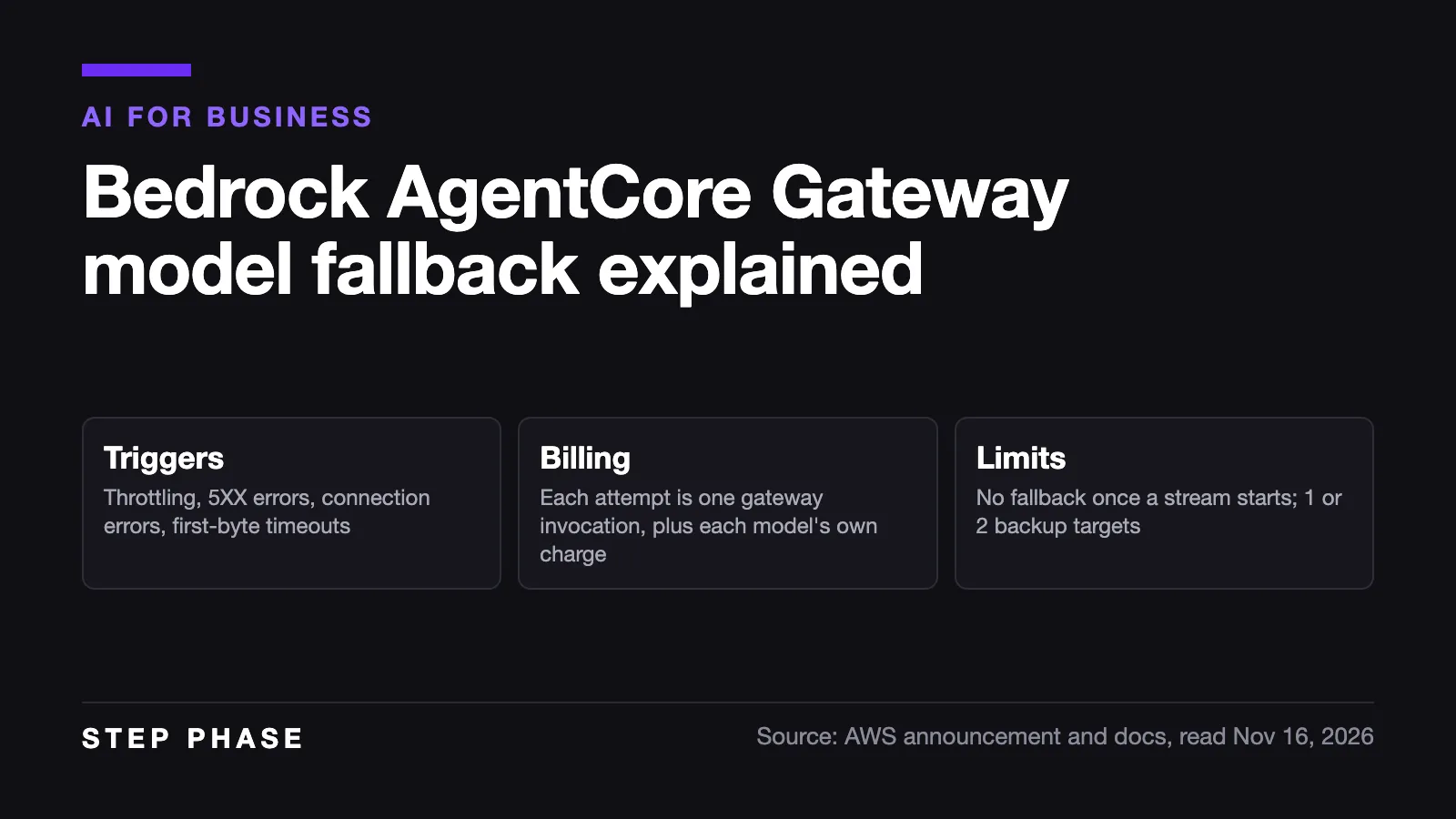
- Triggers: up to ten status codes or classes such as 429 or 5XX, and up to three error types (connection error, first-byte timeout and unroutable). Only error responses trigger fallback.
- A first-byte timeout per destination, so a slow primary can be abandoned.
- One or two alternative targets, each a distinct target and model pair.
- A circuit breaker, on by default, which skips destinations that are failing.
AWS’s AgentCore release notes confirm the same rule design. A request that matches no trigger goes back to the caller unchanged. The walk-through points out that a malformed-request error such as 400 would probably fail on the next model too, so it usually should not trigger a switch.
How much does fallback cost?
The announcement carries no pricing, but the walk-through is explicit: each outbound attempt is billed as one gateway invocation, and Bedrock or the model provider bills each attempt’s model cost separately. The circuit breaker affects the bill too. While it is closed, failed primary attempts are billed. While it is open, the primary is skipped and skipped attempts are not billed. In the half-open state a small share of requests tests the primary, and those tests are billed. Disabling the breaker may make sense if you would rather keep a cheaper primary than fail over to a costlier secondary, in which case the chain runs in the order you declared.
Where does fallback stop working?
A hands-on write-up from Classmethod, dated October 25, tested the feature in us-east-1 and recorded several limits that matter before production use:
- Streaming: once a streamed response has started, fallback is no longer possible. In the tester’s run a mid-stream failure ended the output abruptly, with no error event.
- Gateway-side rejections: fallback did not fire on the gateway’s own 429 rate limit or on a 403 from a policy, even when listed as a trigger.
- Which model answered: the caller is not told. Use the gateway’s routing logs to see where requests went.
- Different models, different answers: a fallback model can behave differently, so test every model in the chain.
- Supported APIs: only InvokeModel and its streaming version; the tester’s Converse API calls returned a 400.
- Permissions: the gateway role needed
bedrock:List*in addition to the invoke permissions.
The same write-up measured the circuit breaker against a stalled primary: 20 calls took 93.5 seconds with the breaker disabled and 70.1 seconds with it enabled, with later calls dropping to about 1.5 seconds. The tester saw it open after roughly 10 to 11 failures, a threshold that is neither documented nor configurable. This was one test with a simulated provider, not a benchmark.
Who should use it?
Teams that run production agents on one model have a single point of failure when that model is throttled; a second target is cheap insurance, provided someone has checked the cost and quality of the backup. For more on agent tooling and pricing at AWS, see our reports on AWS Kiro bots, ChatGPT Enterprise on AWS Marketplace and Claude’s API price cut.
Sources: AWS What’s New, October 22, 2026; Amazon Bedrock AgentCore release notes; AWS Builder Center; Classmethod. All read on November 16, 2026.
Like our coverage? Add stepphase.com as a preferred source on Google to see more of our stories in Top Stories.

