
Anthropic has launched Claude Ship, a set of agents that take a GitHub pull request through review, fixes and an approval decision. It was announced on November 23, 2026 and is available in beta on Claude Team and Enterprise plans for repositories hosted on GitHub. The part that has drawn attention is Claude Approvals, an agent that can approve routine pull requests on its own when a team’s written policy allows it. Here is what each piece does, how it is billed and what admins control.
What is in Claude Ship?
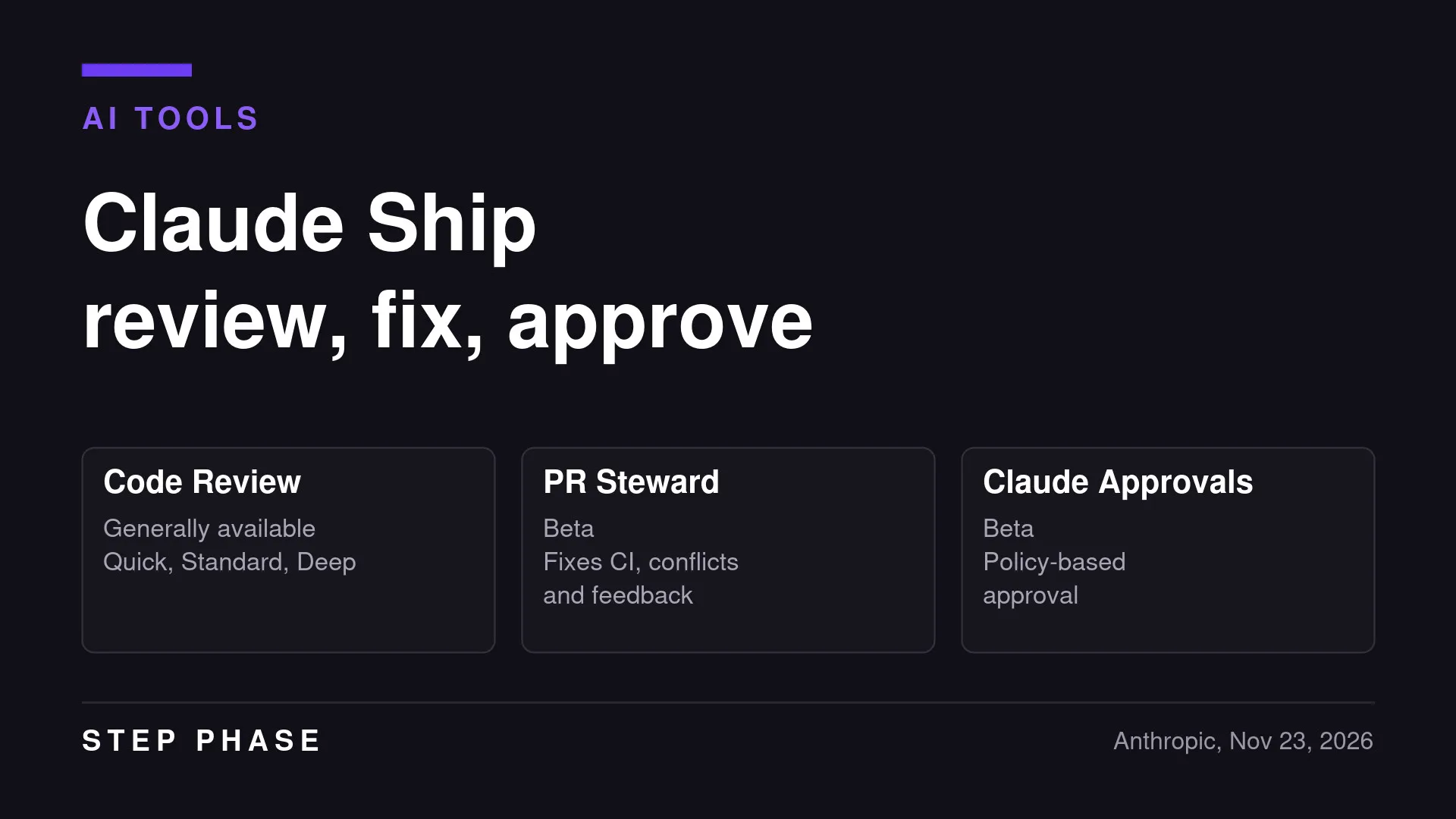
Anthropic’s announcement says Claude Ship is made up of Code Review, which is already generally available, and two new agents in beta, PR Steward and Claude Approvals.
- Code Review reviews a pull request against the codebase “through multiple lenses”. Anthropic says it collects findings, adversarially verifies them, categorises them and posts them to the pull request. Each repository can use a Quick, Standard or Deep review level.
- PR Steward works to keep a pull request passing but is designed not to approve or merge it. It steps in on failing CI checks, merge conflicts and review feedback from Code Review, other review tools or team members. After every push it comments on what it changed and how to undo it. Developers can comment
@claudewith an instruction to steer it, or@claude stopto make it step back. - Claude Approvals applies an approval policy that the team writes as a file in the repository. It can approve routine changes if the policy allows, or require deeper human sign-off for certain scenarios. Anthropic describes it as working like “a smarter CODEOWNERS file”. Policies can use Code Review findings or a team’s own classifiers written in natural language.
TechCrunch, which covered the launch the same day, calls the approval agent the more interesting part, since AI coding tools already offered code review, and notes that it effectively delegates approval authority to an AI agent under rules a team sets.
How teams turn it on
Anthropic describes two routes. Developers can update Claude Code and run the new /ship command on a change: Claude pushes it, opens the pull request, reviews it and works on feedback and failing checks. What can merge still depends on the developer’s permissions and the repository’s branch rules. Anthropic says /ship is rolling out in Claude Code and the desktop app.
For whole repositories, admins decide where it runs, one repository at a time. An admin turns on Code Review and PR Steward for each repository. Claude Approvals starts when a connected repository has a policy file on its default branch, and an admin can turn it off. Admins also choose the review level and when reviews run, and set spend limits. Anthropic says Claude Ship works with existing branch protection and required checks.
For most customers, Anthropic recommends enabling Claude Approvals first in observe-only mode to build confidence before configuring branch protection to require its green light. TechCrunch repeats that advice.
What does it cost?
Anthropic says Claude Ship usage is billed on tokens, so turning it on can add to an organisation’s costs. The amount depends on how many pull requests are covered, their size, the review level, how often reviews run and how much work PR Steward does. Admins can set spend limits for Code Review and PR Steward. Claude Approvals has no base charge, but classifiers in a policy are billed on the tokens they use, and a policy that relies on Claude’s review triggers a billed Code Review, even in observe mode. Running /ship counts as regular Claude Code usage.
Anthropic is also offering launch credits: eligible Claude Enterprise organisations can claim at least $10,000 in Claude Ship credits, to be used within 30 days of claiming. The claim deadline is January 15, 2027, and terms apply.
Who cannot use it
- Claude Ship is for Team and Enterprise plans only, and for repositories on GitHub.
- It is not available to organisations that use Zero Data Retention, the HIPAA configuration or customer-managed encryption keys.
- PR Steward and Claude Approvals are beta features. Code Review is the generally available piece.
What the evidence says so far
The figures in the announcement come from Anthropic’s own Claude Code team, which says merged pull requests more than doubled from June to September while the share reverted fell by more than 40%, with Claude’s review as one layer of a broader process. That is a vendor’s account of its own use, not an independent measurement, and Anthropic does not say how those numbers would carry over to other teams. The launch post also includes two customer quotes, from a director of engineering and a senior vice president of engineering, describing a pilot of PR Steward and the automatic start of the three agents.
What a team lead can do first
- Check the plan and data settings: Team or Enterprise, GitHub-hosted, and not under Zero Data Retention, HIPAA or customer-managed keys.
- Start with one repository, a review level and a monthly spend limit.
- Write the approval policy and run it in observe mode, then compare its decisions with what human reviewers actually did before requiring its approval in branch protection.
For Claude pricing context see our Claude 5.5 pricing and benchmarks and the AI API price comparison for November 2026. For other coding tools, see our comparison of AI coding agents.
Sources
- Anthropic: Introducing Claude Ship (November 23, 2026)
- TechCrunch: Anthropic launches Claude Ship (November 23, 2026)
Like our coverage? Add stepphase.com as a preferred source on Google to see more of our stories in Top Stories.

