
Attackers are exploiting CVE-2026-84869, a critical flaw in the ScreenConnect client, to run files on the computers of IT technicians who connect to remote sessions. ConnectWise fixed the bug on September 8, 2026 in ScreenConnect 26.6.5 and rated it CVSS 9.9. On November 16 the security firm Huntress published evidence of real compromises, and The Hacker News repeated the warning on November 23. The detail that catches teams out is that the vulnerable code runs on the technician’s machine, so updating the server alone does not fix it. Here is what is affected, the fix, the workaround and what Huntress says to hunt for.
What is CVE-2026-84869?
ConnectWise’s bulletin for the 26.6.5 security patch describes a client condition that may allow files to be transferred and executed during an active remote session without authorisation or Host confirmation, in certain circumstances. It lists two weakness types, missing authorisation (CWE-862) and improper privilege management (CWE-269), and a CVSS 3.1 base score of 9.9. ConnectWise gives the patch its highest priority and says “ScreenConnect servers are not impacted”. The bulletin withholds further technical detail.
Huntress fills in the mechanics. A guest in a Support or Access session can trigger file-transfer actions that the technician’s host client processes without a prompt, including running files with elevated rights. The technician only has to join a session. That session can be one the attacker controls, or a genuine customer session the attacker has joined as an extra guest.
Which versions are affected and what is the fix?
- Affected: all versions before 26.6.5, per the ConnectWise bulletin. Huntress notes many technicians were still on 22.x, 24.2 and 25.8 clients weeks after the fix shipped.
- Fixed: ScreenConnect 26.6.5. Cloud instances were already upgraded, but ConnectWise still tells customers to reinstall host clients and update Access agents.
- On-premises: upgrade to 26.6.5. ConnectWise says you must be on 25.4 or later to upgrade directly and your licence must be under maintenance, or be upgraded first.
- Interim workaround: in Administration, Security, Roles, deselect the TransferFiles permission (previously TransferFilesInSession) on each role and on each session group that carries permissions. ConnectWise calls this temporary and not a substitute for the patch.
After patching, ConnectWise advises reviewing users and removing unrecognised accounts, checking roles and permissions, changing passwords and enabling multi-factor authentication.
What has Huntress seen in the wild?
Huntress reports that between October 20 and November 16 it recorded at least 688,000 guest “run file” requests across 42 MSP ScreenConnect servers from 29 IP addresses. They repeatedly offered a file named update.bat or update_<8 hex>.bat, apparently waiting for a technician to connect. The busiest server saw 70,414 requests from 10 guest sessions over three weeks.
One compromise is documented step by step. On November 12 a technician joined a blank-named Access session and the host client ran a pushed batch file. In about nine seconds it reported the new victim to a Telegram bot, ran reconnaissance, downloaded WindowsUpdate.msi from masterdarky[.]com, unpacked it without leaving an install record and started a rebranded ScreenConnect client connected to the attacker’s relay on port 8041. The result looked like a legitimate remote-access client named after Windows Update.
Huntress also saw a canary test on November 13, when a guest pushed a harmless marker.txt that opened in Notepad++ on a second MSP’s technician machine, and October attempts to drop a Sync.bat file into a technician’s Windows Startup folder through a path-traversal request. It says the Startup attempts hit two technicians on vulnerable Windows clients and one on a Mac client, where the Windows path failed. Huntress does not establish that persistence succeeded.
Is it on the CISA exploited list?
Huntress says CISA added CVE-2026-84869 to its Known Exploited Vulnerabilities (KEV) catalog on September 11, three days after the fix. We could not confirm the entry through CISA’s own catalog search page, so treat that date as Huntress’s. The Hacker News does not state the KEV status. Federal agencies are not the only audience: the catalog is a useful signal that a flaw is being used against real targets.
What to check now
- Update every technician’s host client and any Access agents to 26.6.5 or later, not just the server. Huntress says unpatched clients were the gap.
- If you cannot patch today, remove the TransferFiles permission as above.
- On the server, Huntress suggests working from a copy of
App_DataSession.dband looking for guest-initiated file events, especially repeatedupdate*.batrequests in blank-named sessions, and any path containing../. Then check whether a technician was connected at that moment, because that overlap is the exposure. - On technician workstations, look for ScreenConnect clients running script files from Temp folders, unknown items in the Startup folder, folders named
wclient_<8hex>under the local app data path and any ScreenConnect client pointing to a relay you do not own. - If you find a hit, Huntress advises isolating the workstation, removing the rogue client and rotating every credential that machine could reach, including RMM, PSA, password vault and customer admin accounts.
- Limit who can join sessions as a guest, restrict access to the web interface by IP or VPN and do not join unattended sessions you cannot tie to a customer.
A separate campaign, not to be confused
The Hacker News describes a different wave: a fake-session campaign with crypto-exchange-themed machine names, which it says enrolled 2,408 unauthorised guest sessions since November 3 and touched at least 118 self-hosted servers belonging to 109 Huntress-protected organisations as of November 13. No follow-on malicious activity was observed from those sessions. Huntress also links a separate SCKit toolkit to an authentication flaw in a third-party ScreenConnect extension, and says there is no evidence it bypassed the patch.
For this week’s other actively exploited flaws, see our Exploited This Week roundup.
Sources
- ConnectWise: ScreenConnect 26.6.5 Security Patch bulletin (September 8, 2026)
- Huntress: CVE-2026-84869 in ScreenConnect exploited against MSP technician accounts (November 16, 2026)
- The Hacker News: Hackers exploit critical ScreenConnect flaw to hijack MSP technician PCs (November 23, 2026)
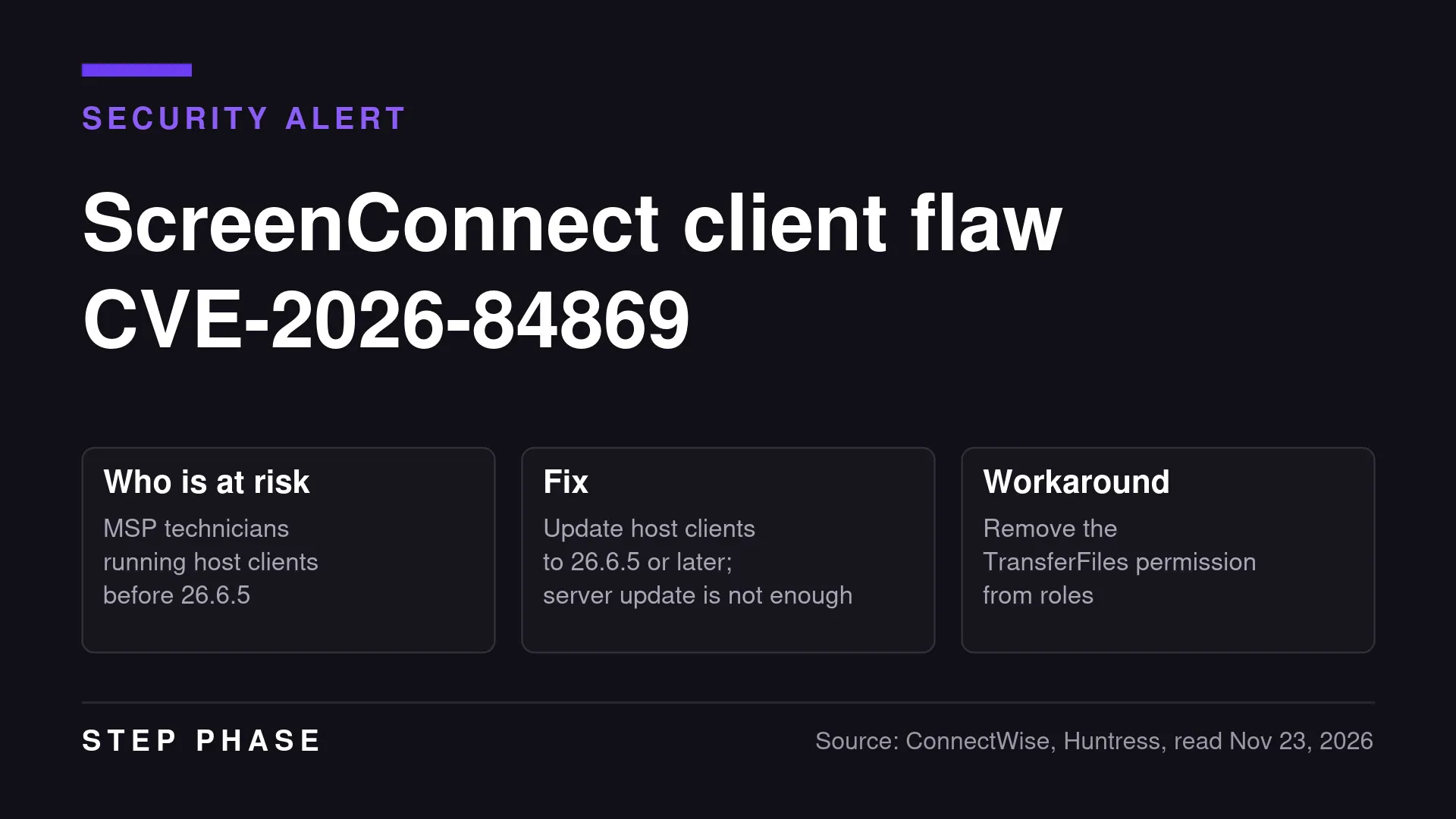
Image: StepPhase title card.
Like our coverage? Add stepphase.com as a preferred source on Google to see more of our stories in Top Stories.

 is exploited against MSP technicians. Update host clients to 26.6.5, the TransferFiles workaround and what to hunt for.)