
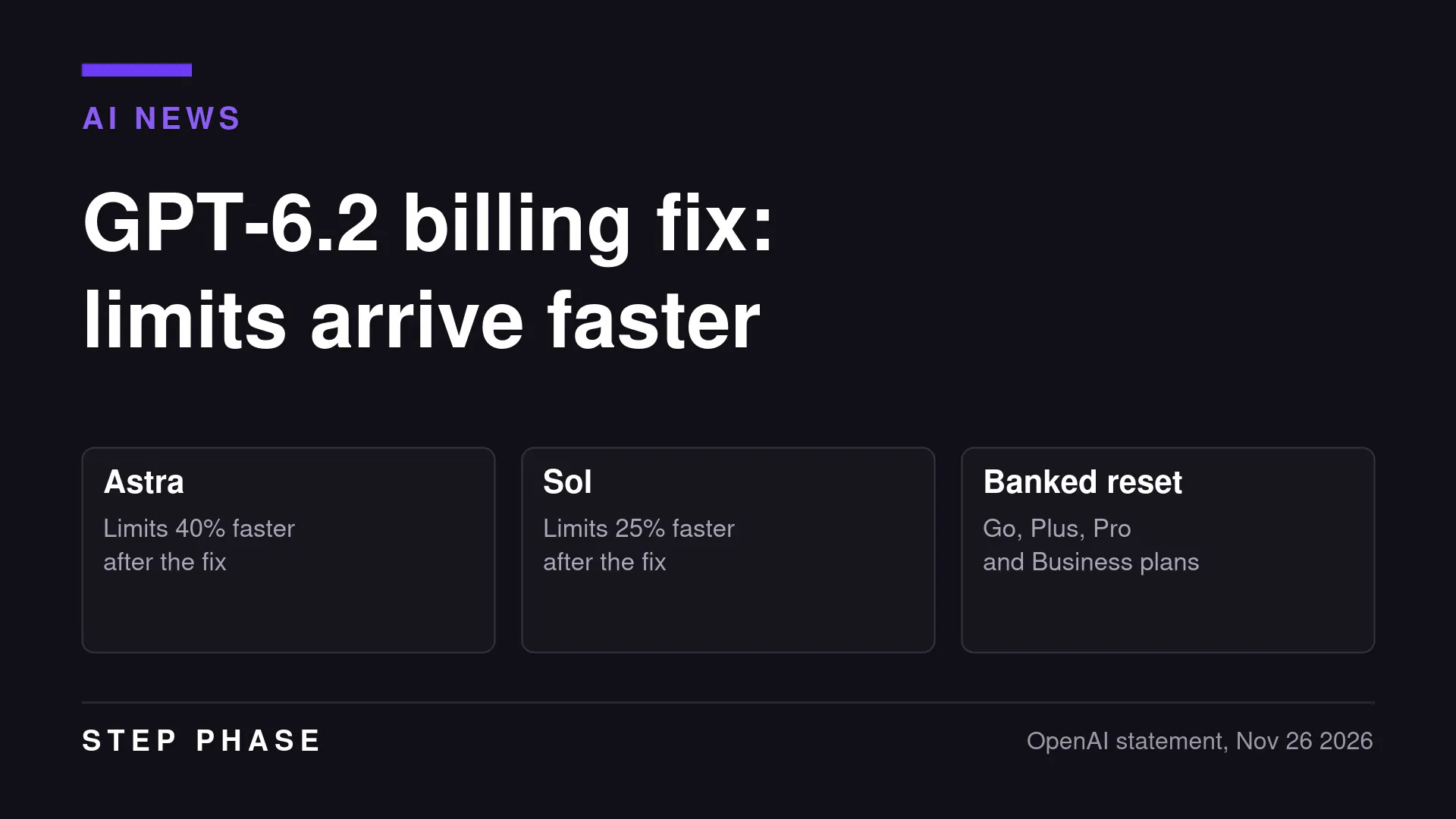
OpenAI said on Thursday, November 26, 2026, that it made a billing mistake when it launched GPT-6.2 Astra and Sol, and that fixing it means the same work now uses more of a ChatGPT plan’s usage allowance. Thibault Sottiaux, who works on ChatGPT and Codex at OpenAI, wrote on X that users “will reach your limits 40% faster on GPT-6.2 Astra and 25% faster on Sol.” OpenAI will not charge anyone retroactively and is giving paid subscribers one banked reset. Here is what was announced, what it does and does not change, and what is still unexplained.
What OpenAI said about the GPT-6.2 billing error
According to the reports we opened, Sottiaux’s post said: “We made a billing mistake at launch of GPT-6.2 that incorrectly discounted GPT-6.2 Astra and Sol usage for most users.” A second line reads: “We’ve fixed this now, so the same work will use more of your plan’s usage allowance.” The two models reached ChatGPT Work and Codex on November 17, so the discounted metering ran for about nine days before the correction, per The Outpost’s summary of InfoWorld, TechRadar and Decrypt coverage.
- GPT-6.2 Astra: limits arrive 40% faster than the week before the fix.
- GPT-6.2 Sol: limits arrive 25% faster.
- Other models: not affected, according to InfoWorld’s report.
- Past usage: OpenAI will not bill customers for the difference.
What “40% faster” means in practice
OpenAI did not say how it measures the figure, and both InfoWorld and Startup Fortune point out the ambiguity. It could mean the same task now draws 1.4 times as much allowance, or that the allowance now lasts 40% less time. By our own arithmetic, the first reading means a fixed allowance covers about 71% of the work it did before on Astra (1 divided by 1.4) and about 80% on Sol (1 divided by 1.25). The second reading is harsher for Astra: the allowance would cover 60% of the old work. Startup Fortune reads it as the 1.4x version and suggests checking your own usage page, which is the only reliable way to see the real effect on your account.
Who gets the banked reset
Sottiaux said OpenAI will add “one banked reset” for everyone on Go, Plus, Pro and Business as an apology. The Outpost says it restores allowances before renewal without raising them permanently, and that it can be redeemed on the ChatGPT desktop app or website settings. Startup Fortune, which cites Notebookcheck for the terms, lists these conditions:
- It can be used only when a covered allowance is below 80% remaining.
- On Plus it resets the five-hour and weekly allowances to 100%; on Go it restores the monthly allowance.
- It works on the web and in the desktop app, but not in the mobile app.
- It expires, and the expiry date is shown before you confirm.
- A full reset changes your weekly reset date.
DataStudios notes that the announcement itself gave no expiry date, so treat the terms above as a secondary report and check the screen in your own account. Enterprise and Edu are not named in the compensation, and no report says whether credit-based Enterprise or Edu workspaces were undercharged during the launch window.
What did not change: API prices
The correction concerns plan allowances, not the developer API. DataStudios lists the API rates per million tokens as $8 input, $0.40 cached input and $40 output for Astra, and $2 input, $0.10 cached input and $10 output for Sol, which match the figures in our GPT-6.2 API price breakdown. For the full comparison across vendors, see our AI API prices guide. Usage beyond plan limits that is paid for with credits costs 3 times the standard rate through February 28, 2027 and 6 times from March 1, according to OpenAI documentation cited by InfoWorld.
What is coming in December
Separately from the fix, OpenAI’s help center says Plus, Pro and Business plans will move to a single token-based allowance shared by ChatGPT and Codex in December, with Instant chat outside it, as Startup Fortune and DataStudios report. OpenAI says it expects most users will not wait for resets more often than now, but a small share of the heaviest users may. The size of the combined pool has not been disclosed. Startup Fortune adds that Business workspaces created from November 23 to 30 get double weekly usage for Work and Codex until December 31.
Admins who manage seats should also read our guide to GPT-6.2 in Microsoft Copilot, which covers a different billing path for the same models.
What analysts advise buyers to do
Sanchit Vir Gogia of Greyhound Research told InfoWorld that OpenAI did not raise its price but changed how much work the price buys, and he advised rerunning the same tasks on the corrected metering and negotiating a defined work-to-allowance conversion in contracts. Neil Shah of Counterpoint Research called the lack of transparency the core problem and recommended a 30% to 40% contingency buffer in AI budgets, moving production workloads to direct API metering, and benchmarking Claude and Gemini on actual unit costs. These are their views, not OpenAI’s.
What is still unclear
- OpenAI has not said what caused the discount, which users escaped it, or what the corrected metering rates are.
- The exact meaning of “40% faster” is undefined.
- The size of the December shared allowance is unannounced.
- OpenAI had not responded to InfoWorld’s or Decrypt’s requests for comment when those reports ran.
Subscribers can open their usage page, note how much allowance a typical task now takes, and decide whether to spend the banked reset now or keep it for a heavy week.
Sources
- InfoSec Today (InfoWorld syndication): OpenAI’s GPT-6.2 correction means you get less AI for the same fee
- The Outpost: OpenAI fixed a ChatGPT billing mistake (November 26, 2026)
- Startup Fortune: OpenAI fixes GPT-6.2 billing error and ChatGPT users will hit limits sooner (November 26, 2026)
- DataStudios: ChatGPT users hit GPT-6.2 Astra limits 40 percent faster after billing fix
Like our coverage? Add stepphase.com as a preferred source on Google to see more of our stories in Top Stories.

