
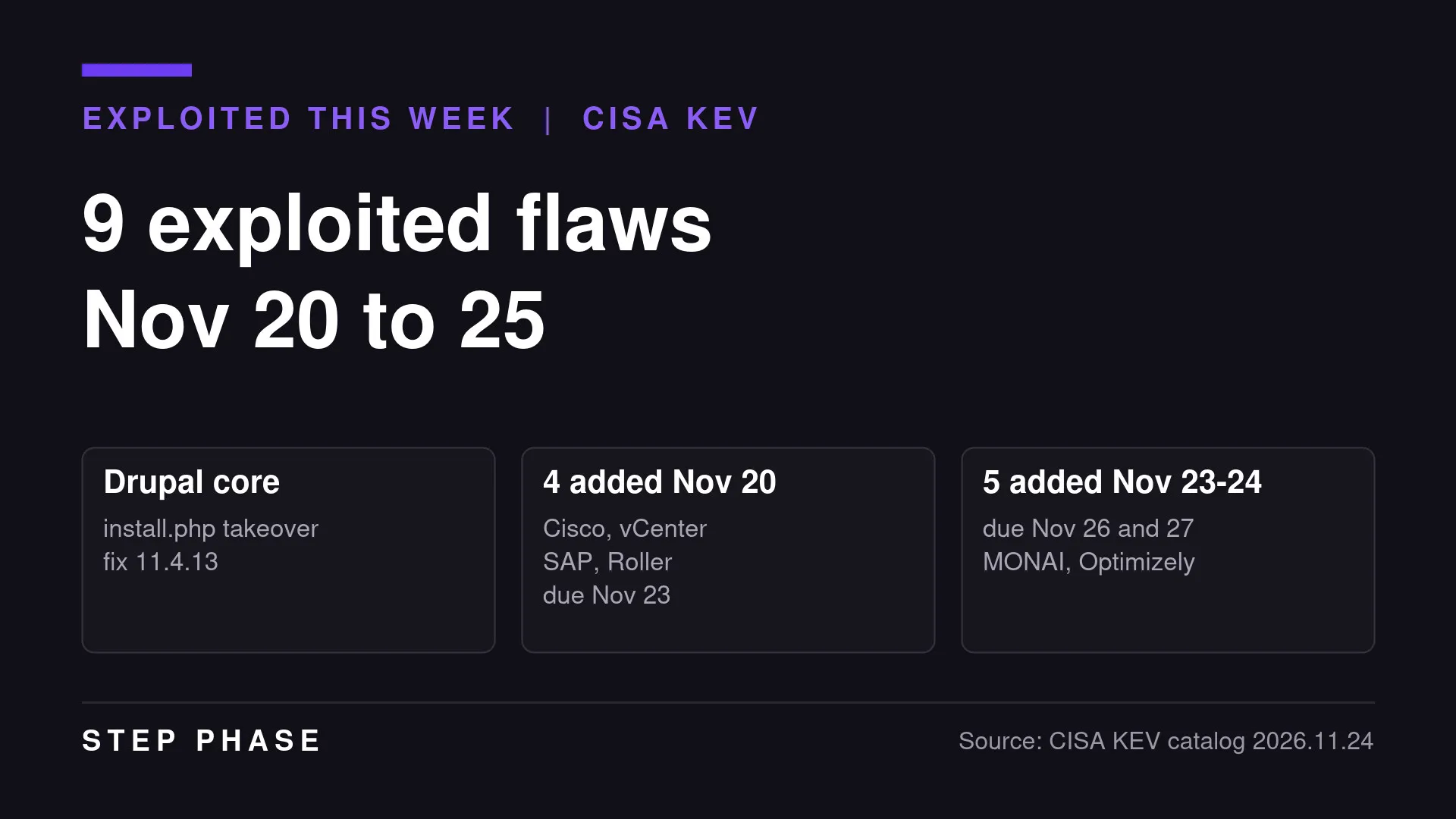
Date range covered: CISA additions dated November 20 to November 25, 2026. In that window the US Cybersecurity and Infrastructure Security Agency (CISA) added 19 vulnerabilities to its Known Exploited Vulnerabilities (KEV) catalog, which means it has evidence each one is being used in real attacks. The additions came on four days: four on November 20, two on November 23, three on November 24 and ten on November 25. The catalog (version 2026.11.25, opened on November 27) shows no entries dated November 21, 22 or 26. Due dates, vendors and descriptions come from the KEV catalog; fixes come from the vendor advisory where we could open it, and we say so where we could not. Our previous roundup covered November 13 to 19. CISA lists known ransomware campaign use as “Unknown” for all 19.
Which flaws have the shortest deadlines?
- November 23: Cisco Expressway CVE-2026-76466, Broadcom VMware vCenter CVE-2026-123890, SAP NetWeaver CVE-2025-42884 and Apache Roller CVE-2026-129448.
- November 26: Project MONAI MONAI Label CVE-2026-133968 and N-able MailAssure CVE-2026-134624.
- November 27: Drupal core CVE-2026-132165, Optimizely Web Experimentation CVE-2026-132224 and Idunno AntiCsrf CVE-2026-131914.
- November 28: Mitel MiCollab CVE-2026-133275, CVE-2026-133303, CVE-2026-133323 and CVE-2026-133324, Vates Xen Orchestra CVE-2026-133469, HPE Juniper Session Smart CVE-2026-103406, and Danfoss AK-SM 800A CVE-2023-25914 and CVE-2023-25915.
- December 9: Mitel MiCollab CVE-2026-133311 and Danfoss AK-SM 800A CVE-2025-41450.
November 20: Cisco, vCenter, SAP and Roller
- CVE-2026-76466, Cisco Expressway Series (due November 23): a hard-coded credential in the cluster database that lets an unauthenticated attacker run commands as root on a clustered device. Only clustered systems are affected. Release X15.5.20 is the first fixed release on that line; X14 and earlier have no fix on their own branch and Cisco lists no workaround. See our Cisco Expressway guide.
- CVE-2026-123890, Broadcom VMware vCenter (due November 23): an authentication bypass in the VMware Directory Service, patched by Broadcom on November 19 after Google said a suspected China-linked group had used it as a zero-day since early September. Broadcom lists no workaround. The fixed builds we report, vCenter 9.1.1.0200, 9.0.2.0200 and 8.0 U3m, come from the advisory as relayed by security sites, so check Broadcom’s table before patching, and vCenter 7.0 has no published fix. See our vCenter guide.
- CVE-2025-42884, SAP NetWeaver Enterprise Portal (due November 23): a JNDI injection that lets an unauthenticated attacker steer the portal’s lookups. SAP fixed it on November 11, 2025 in Security Note 3660969 and rated it only Medium, which is why it may have sat low on patch lists. We could not open the note, which needs a login. See our SAP guide.
- CVE-2026-129448, Apache Roller (due November 23): unauthenticated remote code execution through the XML-RPC endpoint, affecting versions up to 6.1.5. Roller 6.1.6 is the first fixed release and 6.1.7 is the current one. See our Roller guide.
November 23: MONAI Label and N-able Mail Assure
- CVE-2026-133968, Project MONAI MONAI Label (due November 26): a path traversal that lets an unauthenticated attacker write files outside the datastore and reach code execution. Fixed in MONAI Label 0.8.6; the maintainers’ workarounds are to turn authentication on and keep the server off untrusted networks. Amazon says AI agents used it against a university server. Read our MONAI Label story.
- CVE-2026-134624, N-able MailAssure (SpamExperts) (due November 26): a server-side request forgery in the LDAP synchronisation connection check that lets an authenticated API user reach internal hosts and ports. Security Affairs reports builds before 20261121.1943 are affected, and customers running their own builds should confirm they are on that build or later. We cover it in the MONAI Label story above.
November 24: Drupal, Optimizely and Idunno AntiCsrf
- CVE-2026-132165, Drupal core (due November 27): an installer flaw that can let an unauthenticated attacker reinstall a site through
install.php, leading to takeover or code execution. Drupal says it was exploited from November 19. Fixed in Drupal 11.4.13, 11.3.22 and 10.6.22; older branches are end of life. See our Drupal guide. - CVE-2026-132224, Optimizely Web Experimentation (due November 27): a flaw in the account signup flow that let an attacker impersonate users on targeted customer accounts and insert malicious JavaScript into some customers’ projects. Optimizely’s status page says the activity began on November 16, the hole was closed within three hours of detection, fewer than 5 percent of customers were affected, the injected code was removed and it was not a credentials breach. Customers who use Web Experimentation should check Optimizely’s direct message or its support team, since the status page lists no specific steps. CISA asks for forensic triage on this one.
- CVE-2026-131914, Idunno AntiCsrf (due November 27): a deserialization flaw in an old ASP.NET anti-CSRF library. Mandiant’s advisory (MNDT-2026-0048, published November 18) says an unauthenticated attacker can get code execution in the IIS worker process with one POST request, rates it 9.3 on CVSS 4.0 and reports exploitation in the wild. There is no patch: the project is defunct, last released in December 2008 as version 0.9.1 Beta. Mandiant’s advice is to remove the library and use a supported anti-forgery mechanism, and to search
Web.configandbin/for the module.
November 25: Mitel MiCollab, Xen Orchestra, Juniper and Danfoss
- Five Mitel MiCollab flaws (four due November 28, CVE-2026-133311 due December 9): CVE-2026-133275, CVE-2026-133303, CVE-2026-133311, CVE-2026-133323 and CVE-2026-133324, all in the Audio, Web and Video Conferencing (AWV) component and all open to an unauthenticated attacker. Mitel’s advisory MISA-2026-0012 (first issued November 16, updated November 24) rates the command injection CVE-2026-133323 critical at CVSS 10.0 and the XML injection CVE-2026-133303 critical at 9.0; the file upload, weak authentication and authentication bypass bugs are rated medium. Mitel warns that chaining them amplifies the impact. MiCollab 10.3 (10.3.0.18) and earlier are affected: apply Mitel’s patch for 10.3.0.18 (knowledge base article KB000129195) or move to a later release. If you cannot patch yet, Mitel’s workaround is to block external access to the AWV component.
- CVE-2026-133469, Vates Xen Orchestra (due November 28): a login cookie holding an empty JSON object lets an unauthenticated attacker act with Admin rights. Vates’ advisory VSA-2026-062 says it is actively exploited and that a compromise can lead to code execution on managed pools and root takeover of XCP-ng hosts. Fixed in Xen Orchestra 6.9.2 (stable channel) and 6.10.1 (latest channel); the Xen Orchestra Appliance is affected too. Vates lists what to hunt for, including a running VM named “pivot2” and files such as
/etc/ld.so.preloadand/etc/cron.d/zz-ustar, and says not to expose Xen Orchestra to the internet. - CVE-2026-103406, HPE Juniper Session Smart Conductor and Session Smart Router (due November 28): an OS command injection through a specially crafted Salt minion ID that lets a remote attacker run commands as root, according to CISA. CISA points to Juniper’s October 2026 on-demand security bulletin for Session Smart Router and Conductor. Juniper’s support portal would not load for us, so check that bulletin for the fixed releases.
- Three Danfoss AK-SM 800A Series flaws: CVE-2023-25914, a path traversal through the XML interface that exposes system files, and CVE-2023-25915, an input validation flaw that allows remote command execution (rated 9.8 by Danfoss), are both due November 28 and fixed in software version 3.3 (Danfoss advisory DSA-2023-08-01, August 2023). CVE-2025-41450, an authentication bypass that lets an attacker generate a web report showing internal IP addresses, usernames and store names (rated 8.2), is due December 9 and fixed in version 4.2 (DSA-2025-03-01, March 2025). These are old bugs; the KEV entries do not say when or by whom they were exploited.
What should you do this week?
- Check what you run. Look for Drupal sites, Cisco Expressway clusters, vCenter, SAP Enterprise Portal, Roller blogs, MONAI Label, Mail Assure, any ASP.NET WebForms app that bundles AntiCsrf, Mitel MiCollab, Xen Orchestra, Juniper Session Smart routers and conductors, and Danfoss AK-SM 800A controllers. Most of the November 25 additions are due on November 28, one day after this roundup.
- Start with internet-facing systems. CISA’s binding directive for federal agencies, BOD 26-04, puts known-exploited flaws on publicly exposed assets first.
- Patch, then look back. CISA asks for forensic triage on all 19, so review logs, new accounts and unexpected processes on anything that was exposed and unpatched.
- If there is no patch, remove the product: AntiCsrf, Drupal 10.5 and older, and vCenter 7.0 have no fix on their branch.
What is still unknown?
CISA’s entries do not say who is exploiting these flaws, how many systems are affected or what attackers do after getting in. We could not read SAP’s note or Juniper’s bulletin. Anything CISA adds after catalog version 2026.11.25 falls outside this roundup.
Sources
- CISA Known Exploited Vulnerabilities Catalog (version 2026.11.25, for dates and due dates)
- Drupal security advisory SA-CORE-2026-017
- Mandiant advisory MNDT-2026-0048 (Idunno AntiCsrf)
- Optimizely status page incident
- MONAI Label advisory GHSA-qc22-rmgc-vg94
- Mitel advisory MISA-2026-0012 (MiCollab)
- Vates advisory VSA-2026-062 (Xen Orchestra)
- Danfoss advisory DSA-2023-08-01 and DSA-2025-03-01 (AK-SM 800A)
Like our coverage? Add stepphase.com as a preferred source on Google to see more of our stories in Top Stories.

