
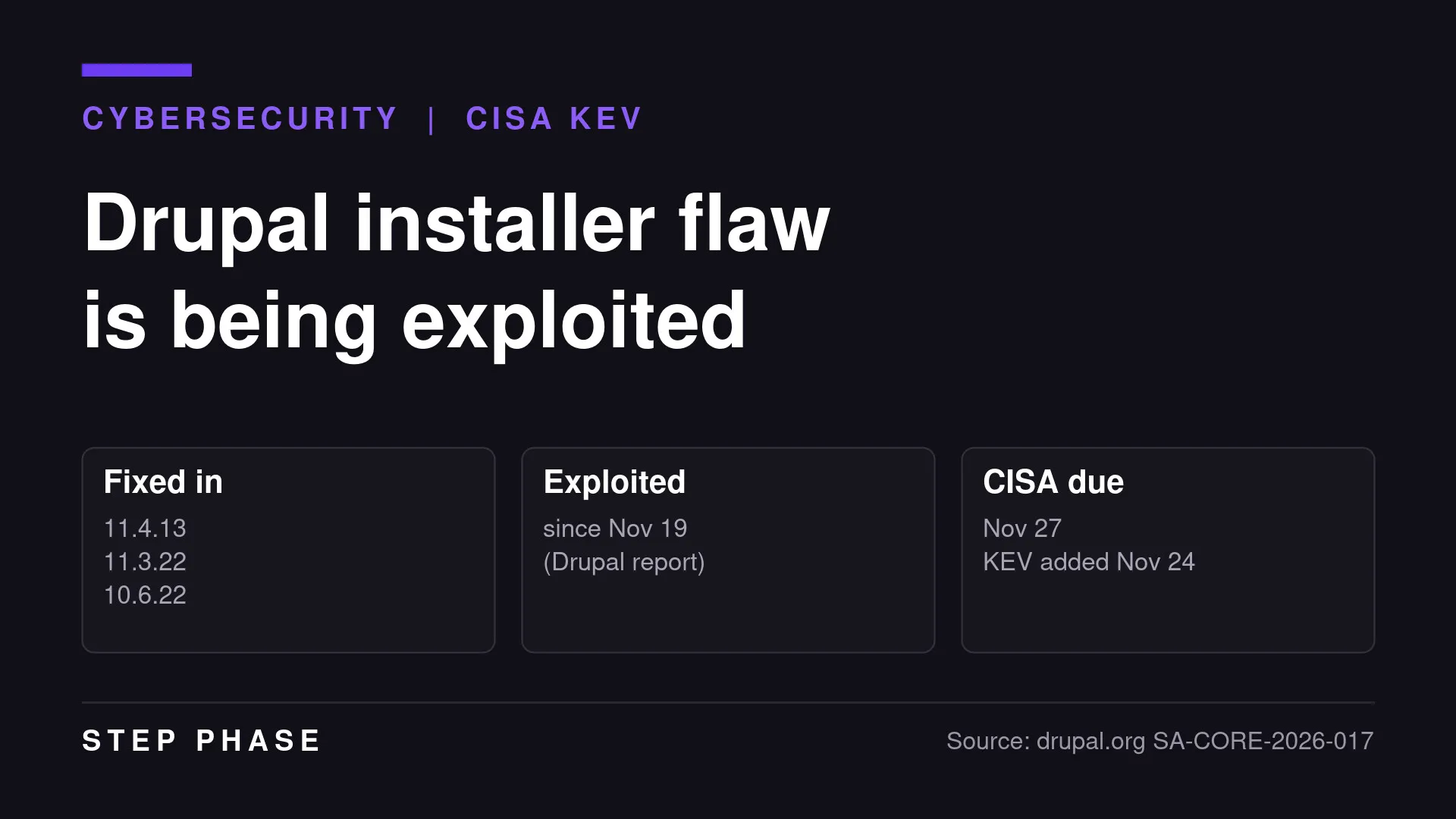
Drupal core has a flaw in its installer that is now being used against live sites. CVE-2026-132165, published as security advisory SA-CORE-2026-017 on November 18, 2026, lets an attacker under specific conditions reinstall Drupal through install.php, which can end in a site takeover or remote code execution. Drupal says it received a report of exploitation as early as November 19, 2026 at 19:00 UTC, and CISA added the flaw to its Known Exploited Vulnerabilities (KEV) catalog on November 24 with a federal due date of November 27. The fix is in Drupal 11.4.13, 11.3.22 and 10.6.22.
What is CVE-2026-132165?
Drupal core ships with an install.php file. According to the advisory, “under specific conditions, an attacker can use the installer to attempt to reinstall Drupal”, and that can lead to a site takeover or remote code execution. Drupal rates it Highly critical, 20 out of 25, with the risk vector AC:Complex/A:None/CI:All/II:All/E:Exploit/TD:Uncommon. In plain terms: no account is needed, the conditions are not trivial to meet, and exploit code exists. The advisory does not list every condition, and this article does not guess at them.
CISA’s catalog entry describes the weakness as a “not failing securely” problem (CWE-636) and says an unauthenticated attacker can take over an existing site or execute arbitrary code through the installer.
Which Drupal versions are affected and which fix it?
- Drupal 10: every release before 10.6.22. Fixed in 10.6.22.
- Drupal 11.0.0 up to 11.3.x: fixed in 11.3.22.
- Drupal 11.4.0 up to 11.4.x: fixed in 11.4.13.
Drupal 11.2.x and below, Drupal 10.5.x and below, Drupal 9 and Drupal 8 are end of life and get no security coverage, so there is no patch for them. Sites on those branches need to move to a supported release.
What did Drupal say about exploitation?
The advisory carries an update: “the Security Team has received a report this was exploited on live sites as early as 2026-11-19 19:00 UTC.” That is about a day after the fix was published. SecurityWeek, reporting on November 25, says there is no public information on the attacks or the attackers, and that it is unclear how many sites are affected. CISA’s entry lists known ransomware campaign use as “Unknown” and flags the flaw for forensic triage.
The advisory credits Anthropic’s OSS Scanner with discovering the flaw, under the identifier ANT-2026-GMRPK0BU, and names Lee Rowlands, Pamela Barone, Scott Euser, Stephan Zeidler and Tyler Nighswander as reporters. SecurityWeek describes the scanner as a free opt-in service that regularly scans enrolled open source projects. It also notes this is the third Drupal vulnerability reported as exploited this year, after CVE-2026-118539 in Commerce Core in October and CVE-2026-9082 in May.
What should Drupal site owners do now?
- Update to a fixed release. Drupal’s first recommendation is to move to 11.4.13, 11.3.22 or 10.6.22, depending on your branch.
- If you cannot update today, secure the installer. Drupal points to its published guidance for securing
install.phpand recommends doing it on every site. - Limit write access to settings.php. The advisory says some, but not all, exploit paths are blocked when the web server cannot write to or change permissions on
settings.php. It is a partial measure, not a fix. - Check sites that were exposed since November 19. Because exploitation began before most teams could patch, review a site for unexpected changes to
settings.php, unfamiliar admin accounts and files you did not add. This is general incident hygiene, not a step from the advisory.
Sites that use Drupal Steward are protected against known attack vectors, but the advisory still tells owners to upgrade soon.
What CISA is asking for
The KEV catalog lists CVE-2026-132165 as added on November 24, 2026, with a due date of November 27. The deadline applies to US federal civilian agencies under CISA’s binding directive. Other organisations are not bound by it, but the catalog is a reliable signal of what attackers are using now. Our weekly Exploited This Week roundup tracks each addition, and another recent KEV addition that gives unauthenticated code execution is Apache Roller CVE-2026-129448.
The second Drupal advisory fixed in the same releases
SA-CORE-2026-018 (CVE-2026-132166), also published November 18, is a gadget chain rated Moderately critical, 14 out of 25. Drupal says it is not directly exploitable on its own: it matters only if a site has a separate insecure deserialization flaw that lets an attacker feed untrusted input to unserialize(). The same three releases fix it, so one update covers both.
Also added to KEV on November 24
CISA added two more flaws the same day, both with a November 27 due date. CVE-2026-132224 affects Optimizely Web Experimentation: a flaw in the account signup flow that could let an attacker impersonate existing customer users and change Project JavaScript, which would then be served to visitors of the affected customer’s website. CVE-2026-131914 affects Idunno AntiCsrf, a deserialization flaw that can give an unauthenticated attacker code execution, in a product CISA says may be end of life. We will cover both in Friday’s roundup.
Sources
- Drupal security advisory SA-CORE-2026-017
- Drupal security advisory SA-CORE-2026-018
- SecurityWeek: Drupal flaw found by Anthropic scanner exploited in attacks (November 25, 2026)
- CISA Known Exploited Vulnerabilities catalog
Like our coverage? Add stepphase.com as a preferred source on Google to see more of our stories in Top Stories.

