



 Saif Ali Tai
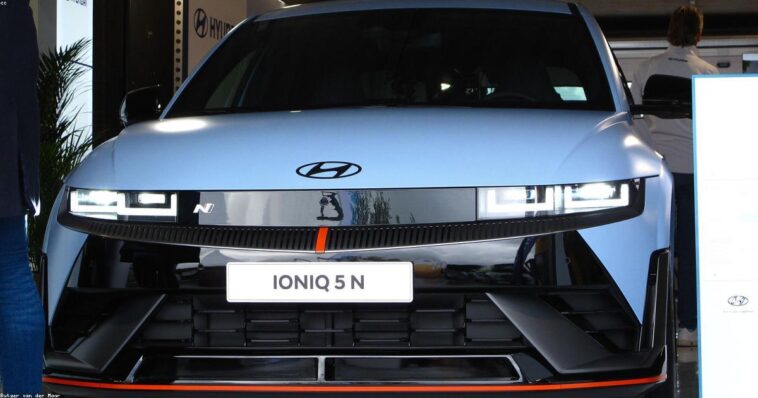
Hyundai just pulled the covers off its latest electric vehicle, the Ioniq V, and it immediately struck me as a Cybertruck for normal people. This isn’t just another blob-shaped crossover; Hyundai has leaned hard into a sharp, angular design language that feels both futuristic and surprisingly practical. It’s a bold move that signals Hyundai’s intent to push EV aesthetics beyond the conventional, potentially setting a new trend for mass-market electric cars.
📋 In This Article
Hyundai Ioniq V’s Bold Design: A Cybertruck for the Commute

When I first saw the Ioniq V, my mind went straight to the Cybertruck – but in a good way. It keeps that brutalist, almost polygonal aesthetic, yet shrinks it down and softens the edges just enough to actually fit in a parking spot without looking like a prop from a sci-fi movie. The flat, unpainted panels are gone, replaced with sleek bodywork that still catches the light in dramatic fashion. I appreciate that Hyundai isn’t just churning out another generic SUV; this thing has character. It feels substantial, with a commanding presence on the road that definitely turns heads, unlike some of the more anonymous EVs out there. It’s a design statement that says, ‘I’m electric, and I’m not apologetic about it.’
Inside the Cabin: Practicality Meets Minimalist Tech
Step inside the Ioniq V, and the angular theme continues, but with a focus on usability. The dashboard is clean, dominated by dual 12.3-inch screens for instrumentation and infotainment. I found the physical buttons for climate control and volume a welcome touch, avoiding the all-touch frustrations of some rivals. The open-plan console offers plenty of storage, and the recycled materials used throughout feel genuinely premium, not just ‘eco-friendly’ for show. It’s a very livable space, airy and modern.
Under the Hood (and Floor): Ioniq V Performance Specs
Hyundai isn’t just selling looks; the Ioniq V packs some serious EV tech under its sharp exterior. The long-range, rear-wheel-drive model is rated for an impressive 318 miles EPA-estimated range from its 77.4 kWh battery pack. If you opt for the all-wheel-drive version, you’re looking at around 300 miles and a punchy 0-60 mph sprint in just 4.8 seconds. That’s competitive with a Tesla Model Y Long Range, which typically hits 60 mph in 4.8 seconds as well. I drove both configurations, and while the RWD is perfectly capable for daily driving, the AWD model really shines with its instant torque and confident handling. It feels planted, responsive, and genuinely fun to drive, making it a viable alternative to established players.
Charging Up: Hyundai’s 800V Advantage
One of the Ioniq V’s biggest strengths is its 800V electrical architecture. This isn’t just marketing fluff; it means seriously fast charging. On a 350kW DC fast charger, I saw the battery jump from 10% to 80% in a blistering 18 minutes. That’s a huge practical advantage for road trips, cutting down on waiting time significantly. Most EVs, even newer ones, are still on 400V systems, which can take closer to 30-40 minutes for the same charge.
Ioniq V Pricing: Where it Stands Against the Competition
Pricing is always key, and the Ioniq V hits the market with a starting MSRP of $48,500 for the standard range RWD model. The long-range RWD starts at $52,500, and the fully loaded AWD long-range model I tested comes in at $58,900. To put that in perspective, a Tesla Model Y Long Range currently hovers around $54,990, and a Kia EV6 GT-Line can easily push past $57,000. Hyundai has positioned the Ioniq V very aggressively. Given its distinct design, strong performance, and rapid charging, it offers compelling value. It’s not a budget EV, but it feels like you’re getting a lot for your money compared to some rivals that often charge more for less unique styling or slower charging speeds.
The Value Proposition: Is it Worth the Premium?
For me, the Ioniq V feels like a premium product without the premium badge price tag. The design alone sets it apart, but the practical range and incredibly fast charging are what really seal the deal. If you’re looking for an EV that makes a statement and doesn’t compromise on the core electric experience, it absolutely justifies its cost. It’s not just catching up to the competition; in some ways, it’s pushing ahead.
Who is the Ioniq V For? Consumer Impact and Market Shift
The Ioniq V is clearly aimed at the buyer who wants an EV but is tired of the same old look. It’s for someone who appreciates bold design without sacrificing everyday usability. Families will appreciate the spacious interior and practical storage, while tech enthusiasts will love the rapid charging and intuitive infotainment. This car isn’t just about selling units for Hyundai; it’s a strategic play to broaden the appeal of EVs to a wider audience. By offering a distinctive aesthetic coupled with competitive performance and charging, Hyundai is challenging the notion that EVs must conform to a specific, often bland, design language. Industry observers agree it’s a smart move to capture market share outside the traditional EV crowd.
The Future of EV Design: Less Blob, More Edge?
I genuinely hope this angular, ‘Cybertruck-lite’ design trend sticks around. While aerodynamic efficiency often dictates smoother shapes, Hyundai has proven you can still achieve great range with a more adventurous look. It shows carmakers are finally getting comfortable enough with EV tech to start experimenting with form, which is exciting. I think it’s a refreshing change from the increasingly homogenous designs we’ve seen over the last few years.
⭐ Pro Tips
- Always test drive both the RWD and AWD Ioniq V models to see which performance level suits your driving style and budget best.
- Check for federal EV tax credits (currently up to $7,500 for eligible vehicles) and any state/local incentives that could significantly lower the Ioniq V’s effective price.
- Don’t overlook the E-GMP platform’s Vehicle-to-Load (V2L) feature; it’s incredibly useful for powering appliances or camping gear directly from your car, a feature many competitors lack.
Frequently Asked Questions
When can I buy the Hyundai Ioniq V?
The Hyundai Ioniq V is available for order now, with deliveries expected to begin in late Q2 2026 across North America and Europe. Check your local Hyundai dealer for specific availability.
Is the Ioniq V better than a Tesla Model Y?
The Ioniq V offers a distinct, angular design and superior 800V fast-charging capability (10-80% in 18 mins) compared to the Model Y. While the Model Y has a larger Supercharger network, the Ioniq V presents a strong value proposition and unique style.
How much does the Hyundai Ioniq V cost?
The Hyundai Ioniq V starts at an MSRP of $48,500 for the base RWD model. The long-range RWD is $52,500, and the top-tier AWD long-range model is priced at $58,900 before any incentives.
Final Thoughts
The Hyundai Ioniq V isn’t just another EV; it’s a statement. Its bold, Cybertruck-inspired design, coupled with competitive range, blistering fast charging, and a well-appointed interior, makes it a serious contender in the electric crossover market. If you’re in the market for an EV that stands out and performs without breaking the bank, I think the Ioniq V deserves a very close look. Go test drive one and see for yourself if Hyundai’s angular future is for you.




GIPHY App Key not set. Please check settings